


The Ghost in the Ledger: How AI is Solving the $100 Billion Unclaimed Property Crisis
For most finance and compliance departments, “unclaimed property” is the administrative equivalent of a recurring migraine. Whether it’s an uncashed payroll check, a dormant savings account, or a forgotten vendor credit, these “ghost” assets represent a massive compliance liability.
With over $100 billion currently held by U.S. state governments and dormancy periods shrinking, the manual “spreadsheets and prayers” approach is no longer sustainable. Enter Artificial Intelligence (AI)—the technology finally turning the tide from reactive reporting to proactive asset management.
The Compliance Burden: Why Manual Systems Fail
The challenge of unclaimed property (also known as escheatment) isn’t just about finding old checks. It’s a multi-dimensional puzzle involving:
- 55+ Jurisdictions: Each with unique laws, deadlines, and dormancy periods.
- Data Silos: Information trapped across ERPs, payroll systems, and legacy databases.
- Fraud Risk: Organized networks increasingly target state portals with sophisticated identity theft.
1. Predictive Dormancy: Stopping Escheatment Before It Starts
The best way to manage unclaimed property is to ensure it never becomes “unclaimed” in the first place. AI excels at Predictive Analytics, analyzing customer behavior to flag accounts at risk of becoming dormant.
- Behavioral Triggers: Instead of waiting for a three-year clock to run out, AI identifies users who haven’t logged in, changed their address, or responded to emails.
- Automated Outreach: Once a risk is identified, AI-driven “Concierge” bots can initiate personalized outreach—via SMS, email, or app notifications—to prompt account activity, effectively “re-starting” the dormancy clock legally.
2. Advanced Data Matching & “Skip Tracing”
One of the biggest hurdles is the “Messy Data” problem. A check issued to “J. Doe” at “123 Main St.” might not match a customer record for “John Doe” at “123 Main Street, Apt 4.”
AI uses Machine Learning and Fuzzy Logic to:
- Clean and Reconcile: Automatically fix typos, abbreviations, and transposed numbers across millions of records.
- Smart Matching: Cross-reference internal data with external public records, social media, and genealogy databases to find the owner’s current address.
- Entity Resolution: Link DBAs, dissolved subsidiaries, and merged entities to ensure all corporate property is accounted for during a merger or acquisition.
3. Fraud Prevention and Identity Verification
As states move to modernize their portals, fraudsters have followed. AI provides a critical layer of defense:
- Anomaly Detection: AI can spot patterns that humans miss—such as thousands of claims originating from the same IP address or multiple names linked to a single bank account.
- Document Forgery Detection: Machine learning models can analyze uploaded IDs and Social Security cards for microscopic inconsistencies, altered seals, or mismatched fonts.
4. Navigating the Regulatory Labyrinth
Keeping up with legislative changes in 50 states is a full-time job. Modern AI compliance platforms now offer:
- Real-time Law Monitoring: AI agents scan state legislative sites for changes in escheatment laws and automatically update the system’s logic.
- Automated Reporting: Generating state-specific reports in the exact format required, reducing the risk of audit-triggering errors.
The Bottom Line: From Liability to Opportunity
Using AI for unclaimed property isn’t just about avoiding fines; it’s about brand reputation and operational efficiency.
| Manual Process | AI-Driven Process |
| Months of data scrubbing | Real-time data reconciliation |
| High risk of audit penalties | Audit-ready digital trails |
| Reactive: “Whack-a-mole” reporting | Proactive: Predictive dormancy alerts |
| Limited to “exact match” searches | Fuzzy logic and global database tracing |
The Future is Here: As digital assets like cryptocurrency and NFTs fall under escheatment laws, the volume of data will only grow. Companies that leverage AI today won’t just stay compliant—they’ll turn a complex legal burden into a streamlined, automated success story.
Reversing the Flow: Using AI to Recover Your Own Assets
While much of the conversation around unclaimed property focuses on a company’s liability to the state, there is a significant, often overlooked opportunity: recovering money that belongs to the company itself.
It is estimated that 1 in 7 businesses have unclaimed property sitting in state coffers—ranging from utility deposits and uncashed vendor refunds to insurance payouts. For large corporations with complex histories of mergers, acquisitions, and name changes, this “hidden revenue” can total millions of dollars. Here is how AI is helping companies flip the script and reclaim their own capital.
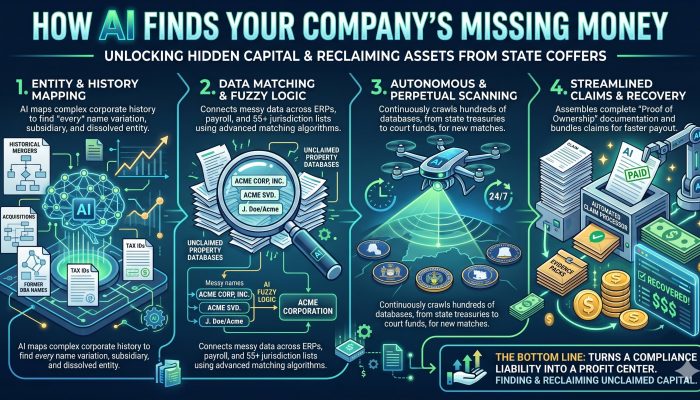
1. Solving the “Identity Crisis” with Entity Mapping
The primary reason corporate property goes unclaimed is that it’s often held under a name the company no longer uses. A refund might be sitting under a subsidiary dissolved in 1998 or a “Doing Business As” (DBA) name from a defunct product line.
- AI Lineage Tracking: AI tools can ingest decades of corporate history—including articles of incorporation, merger manifests, and tax ID changes—to build a comprehensive “Entity Map.”
- Deep Web Matching: These tools then use Fuzzy Logic to search state databases not just for the current legal name, but for every historical variation, common misspelling, and truncated acronym associated with the business.
2. Automated “Set-and-Forget” Monitoring
Manual searches are usually one-off events that quickly become outdated. States update their databases on different cycles (some weekly, some quarterly, some annually).
- Systematic Scanning: AI-powered recoveries act as digital sentries. They crawl hundreds of global databases, from state treasuries to federal courts.
- Proactive Alerts: Instead of a staffer checking every portal every six months, the finance team receives a proactive report when matches are identified, allowing for rapid and continuous claiming as a means of good financial hygiene.
3. Streamlining the Evidence Package
Filing a claim for $50 is easy; filing a claim for $500,000 as a corporate entity is a bureaucratic marathon. States require rigorous proof of “right to claim,” which usually involves historical link-forward documentation.
- Document Assembly: AI can automatically pull the necessary “proof of ownership” documents from internal digital archives—such as old utility bills, lease agreements, or tax filings—and package them according to the specific evidentiary requirements of the jurisdiction.
- Claim Optimization: Large-scale AI systems can identify and bundle multiple smaller claims into a single “Master Claim,” reducing the administrative overhead and accelerating the “check-in-hand” timeline.
Why It Matters: Turning Compliance into a Profit Center
By leveraging AI for recovery, the unclaimed property department stops being a pure cost center and starts contributing directly to the bottom line.
The ROI Fact: AI-driven recovery frequently finds 20–30% more assets than manual searches, often uncovering funds from obscure local jurisdictions (county courts, city municipalities) that internal teams typically overlook.


About Post Author
